
As I start on the leafy tales of betel, I find myself scribbling about a plant that seemed as mundane as a garden plant. I had no idea that the vines of betel leaves in both my ancestral and current homes would unfold into a lush narrative of traditions, memories, and unexpected revelations.
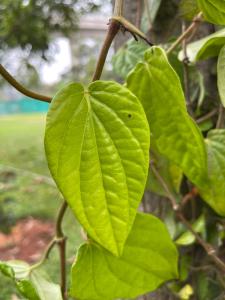
Memories of betel leaf begin with my grandmother. She never chewed it nor possessed a vettila thattam (to place the leaves) or a chellam (a brass box used mostly for holding areca nut, dried tobacco, lime, etc.). But she made use of the vettila(betel leaf in Malayalam) in numerous other ways throughout everyday life. Confirming the mooppu, paakam, or the preparedness of kachiya enna, or medicated hair oil, was the most important one among them. Next was to check the readiness of homemade ghee. She used the leaves when we get colds or a severe cough like in a decoction or just chewed like that. First pain reliever I learnt was from her! When she had a pain, such as a knee or any local pain, she applied sesame oil to the glazy leaf part and keeping it on the hot tawa before applying it to the area for quick pain relief. The same can be done for chest congestions with mustard oil.
I used to be brave enough to take piano, dance, and music lessons as a child, but I never really stuck with it for longer than a few years. During those days, we have offered dakshina to all the Gurus each time the Navrathri or arengettam arrives. That’s when we learned the significance of right way of holding leaves in our hands. Above all, we never had to purchase areca nut and leaves from outside sources for any of our family’s customs. From a child’s conception to one’s mortality! That begs the question, “Is our humble betel leaf also being used in almost every ritual?” in addition to banana leaves. Yes it is!
My first experience chewing paan was at my first office project party, where I tried the sweet paan :P The paan ice cream followed the line! A few years ago, I began experiencing heat boils as my body’s internal temperature and the external temperatures began to get along less well. I received a suggestion on how to have gulkand with paan from the holistic community, of which I have been a part since Little N was born. And believe me, I stumbled upon what home remedy I needed to solve this problem in future.

My sealed mouth doesn’t ask questions, but my inquiring mind always does. I remained astonished as to why betel leaf was so significant in our daily rituals until I received multiple answers from the same group that provided me with the solution to my body heat problem. I’d be delighted to share those with you too. The first is to negate karma. Who doesn’t want to do that, right? Some also believes that Gods we worship are resided throughout the leaf. Jyeshta is located at the point where the stem and leaf meet, while Indra and Shukra are at the top, Saraswati is in the middle, Mahalakshmi is at the bottom, Lord Vishnu is in the glazy area, and Shiva and Kamdeva are on the opposite side. Goddess Parvati and Mangalya Devi on left, Bhoomi devi on right, Lord Surya throughout the leaf. For this reason, we save the bottom tip (Mahalakshmi) on our face’s temples and discard the top tip (where Jyeshta resides) before eating. It makes sense that we serve tambulam to our guests as well as to elders!
Note – For additional rational and useful reasoning, pressing the accupressure points located at the tender depression of the temples on both sides relieves headaches. A similar affect is achieved if you keep crushed leaves or a juice of leaves is applied.
I’m going to pass on a few more tips that I’ve gathered and tried too:
- Chewing betel would help if you’re constipated, have mild indigestion, or feel heavy or full, especially after meals. And that’s just the leaves not as paan.
- For constipation in young kids, the leaf tip is dipped in castor oil and is inserted in region.
- For throat infection – Take a cup of water and boil it. Add 2 medium sized betel leaves roughly chopped with hands only, Add 10-15 Tulsi leaves and add 1-2 cloves grounded into powder. Let this boil for few minutes and then switch off the stove. Once it is warm, you can gargle this. Or once it is cooled, add honey and drink it.
- For improving digestion of new mothers, they were asked to chew betel leaves as part of the postpartum care
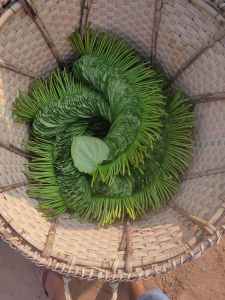
Despite the benefits of betel leaf, everyone has heard about the negative effects of chewing betel, which are primarily caused by lime and betel nut (areca nut). I recall the red-painted roadsides and streets in Pune and Mumbai, as well as numerous true tales of friends who lost loved ones as a result of chewing paan to the extremes. So please exercise caution! Numerous articles have also taught me that chewing paan, along with lime, tobacco and betel nut, was not mentioned in our ancient scripts, which were written before 75 AD. But betel leaf has been mentioned in many. In Skanda Purana, which tells the tale of Samudra Manthan—the churning of the ocean by Gods and Demons seeking Amrit, the nectar of immortality—mentions that betel leaf was one of the numerous celestial objects that were discovered.
Do you know that, there is a specific way of consuming the paan? The science of Iatrchemistry, which is also known as Rasa-jala-nidhi, states that the midrib, veins, and even the smaller ribs must be removed in order to treat Rasa-chikitsa-vidya. Because it could eradicate intelligence and longevity. Then the leaf is placed on left hand, on which one layer of lime or Chuna is applied. A few pieces of crushed areca nut is placed. While some add tobacco pieces, few adds several other spices too. Then it is folded in a certain way and finally goes into the mouth. The first juice that emerges from a chewed betel leaf is harmful and ought to be thrown away. The juice’s third portion, which resembles nectar and aids in the removal of illnesses and senility, is heavier and laxative than the juice’s second part. It also specifies who, how and when betel leaf should be chewed.
Hailing from Kerala, I’ve always heard of Ashtamangala Prashnam and Tambula prashanam, two practices that use betel leaves. Tambula prashnam, also known as vettila jyotisham or betel leaf astrology, is a practice where the astrologer requests that the participant bring a few necessary items, including betel leaves. After seeing the timings they arrived, leaf characteristics (such as color, texture etc), the astrologer would analyze and provide solutions based on the base of his or her planetary positions.
In a manner similar to “Mashinottam”, a method used by astrologers in which a specially made kajal, is smeared to the betel leaf to solve the problem. People who lost any materials or people who experienced a theft, usually seeks Mashinottam. Astrologers who actually do this are getting harder and harder to find, according to my father, who used to believe in all of these things.

In temples as well, betel leaf is essential, especially in the temples of Hanuman. The Ramayana states that when Shri Hanuman arrived in Lanka to deliver Lord Ram’s message to Sita Devi, she was at a loss for what to give him as a sign of gratitude and joy. So, she gave him a betel leaf garland. For this reason, betel leaves are offered as a garland to Shri Hanuman during worship.
A mention of betel leaf can be found in the Mahabharata too. The priests are said to have asked Arjuna to obtain a betel leaf after his victory over evil for the Rajaugya yagnya. Because there were none available in that area, Arjuna had to travel to the Kingdom of Snakes — Naga Loka — and request a leaf from the queen. As a result, the betel leaf is also referred to as Nagvelli or Nagarbel.
Do you know that Lalitha Sahasranam also mentions about Betel leaf?
Lailitha Sahasranamam
Shuddhavidhyaankuraakaara-dhwijapankthi-dhwayojjwalaa
karpooraveetikaamodha-samaakarshi-dhigantharaa ||
Meaning – Devi’s beauty is enhanced by her rows of teeth that resemble the sprouting of pure knowledge. The fragrance of the camphor embedded betel roll in Her mouth is spreading in all directions.
Karpoora veetika is made using spices like cardamom, clove, camphor, saffron, nutmeg, mace and other fragrant items in the betel leaf and rolled well.
According to folklore, while the Pandavas were in exile, Draupadi made a betel leaf kuzhambu when nothing else was available, and it became a tradition to make this when one was sick or to celebrate something auspicious.
Although there isn’t a traditional ceremony without this leaf, there is one festival which gives more importance to vettila. In the month of Dhanu, Thiruvathira, a well-known festival held under the same star, features a ritual known as “108 vettila murukku.” Post the Thiruvathira rituals, ladies would chew 108 vettila until its dawn(they won’t sleep that night as they would have night long activities).
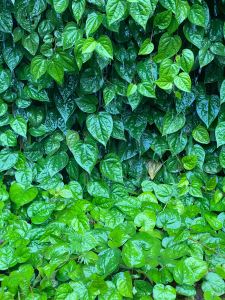
In Kerala, a popular saying among farmers explains the importance of selecting the right part of the plant for propagation and it goes like this “Aadi, Paati, Njaali, Peeta- ആദി പാതി ഞാലി പീറ്റ “.
Krishi Arivu.
Meaning –
Aadi – The first fruit, which is fruited on the topmost branch of the tree, yields the best results further.
Paati – related to the coconut tree. Middle-aged tree must be chosen for coconut seed germination.
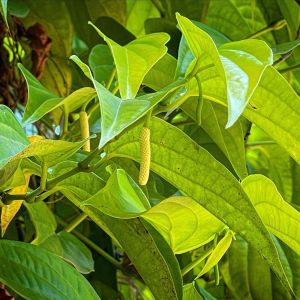
Njaali – A branch that grows downwards from the stem is ideal for sprouting betel leaves or black pepper (‘Njaali’ means hanging).
Peeta – It is best to collect seed from the oldest areca nut tree.
It was only a few years ago that I became aware of the different types of vettila that are available in Kerala. For me, up until that point, every betel leaf was the same. The following species are native to Kerala: Karpoora vettila, Thulasi vettila, Perungodi, Amaravila, Arikkodi, Puthukodi, Nadan, and Koottakkodi and all hails from the Malappuram district. More regional varieties exist too, such as Muvattupuzha local. In Tirur, a small town in Malappuram, a market is known as the Paan bazaar because the main trading commodity itself is betel leaves. The leaves of the Tirur were once exported as far as Pakistan! The subsequent trade wars between the two countries shattered the local growers— hundreds of stores reduced to about two dozen ones operating in Malappuram now— and with time, the Sri Lankan betel leaves overtook them in competition in the export market. Hundreds of stores in Malappuram are now down to about less than 50.
Certain varieties of betel leaves, such as the Tirur vettila from Kerala, the Authoor Vetrilai from Tamil Nadu, the Mysore betel leaf from Karnataka, and the Banaras paan from Uttar Pradesh, have been assigned Geographic Indication (GI) tags. This itself shows the uniqueness in each variety.
I adore the way plants are woven into folklore tales. Do you as well? I’ve read two legendary folk tales about how the three ingredients of paan (betel leaf, nut, and lime) came to be. The Vietnamese tale centers on Tan and Lang, twin brothers, and Tan’s wife. Another one is about rich and poor people from Meghalaya.
As usual, I’ve included the khazaana of recipes that I’ve saved from different websites below.
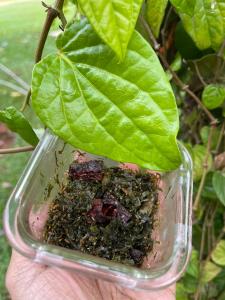
- Paan Gulkand icecream cake from my great inspirer Deepa
- Paan shots from Hebbar’s Kitchen
- Vetrilai thokku from another great inspiration – Neeraja(Nees Kitchen)
- Vetrilai Poondu Saadham from Neeskitchen
- Vetrilai Chutney from Neeskitchen
- Veelyadele Saaru, a Karnataka style rasam
- Vetrilai Rasam by Prema’s Culinary
- Vetrilai Kuzambu
- Betel Leaves rice
- Paan Laddoo
- Miang Kham, Betel leaf wrap from Thai Kitchen
- Betel leaf with grilled paan
- Betel leaf Bhaji
- Paan wine
- Betel leaf drink
- Betel Leaf Mousse
- Roasted coconut-betel leaves
- Betel leaf sambal
- Paan shrikand
- Tender jackfruit & betel leaves recipe
- Paan truffles
- Betel leaf Rasam -Millet rice
- Kuih Daun Kaduk
What do you remember about betel leaf, then? Share it in the comments below.
A.
 MY LITTLE THOUGHTS LANE
One response to “Betel Leaf”
[…] Betel […]
LikeLike