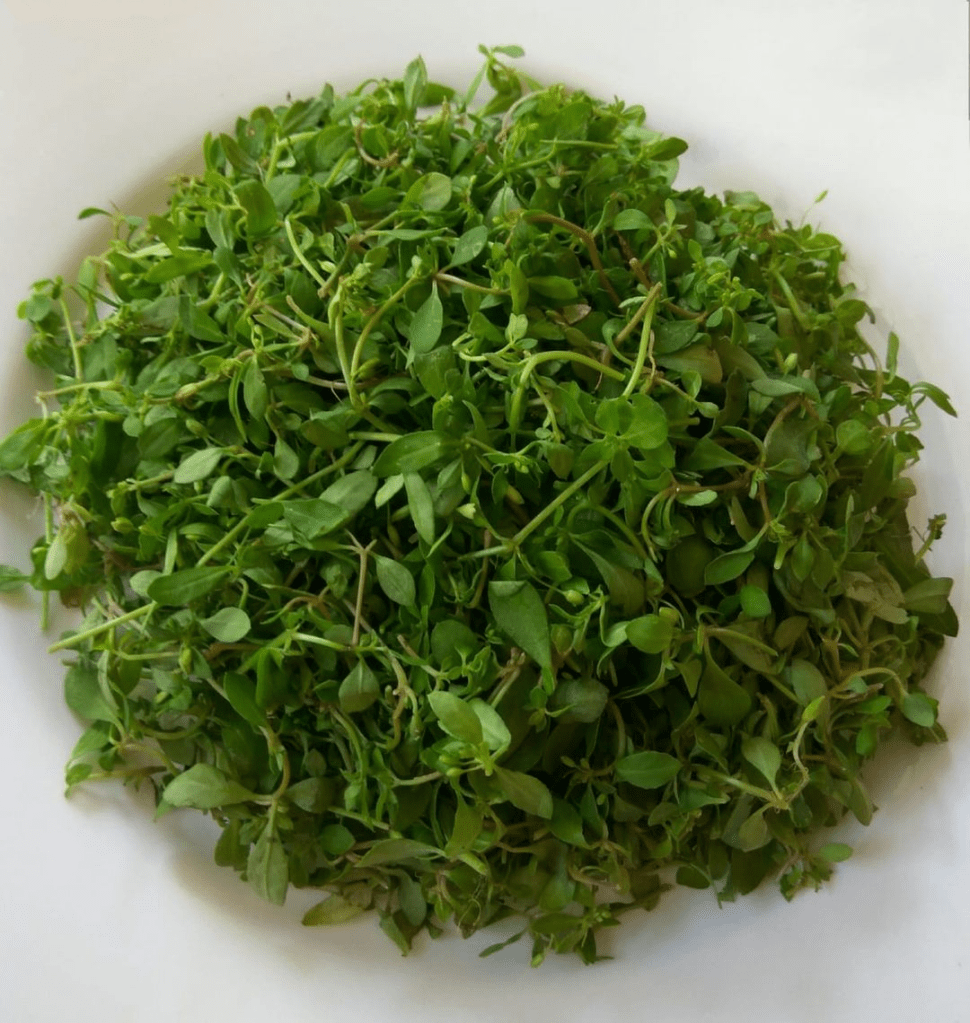
Pic source – Rac Bhat
Family: Molluginaceae (Carpetweed family)
Synonyms: Trigastrotheca pentaphylla
Common names from flowersofindia.net: Five Leaved Carpetweed, Mollugo • Assamese: পথাৰ সুন্দৰী বন Pathara Sundarai Bana • Bengali: জল পাপরা Jul-Papra, খেত পাপরা Khet-Papra • Dogri: पपोड़ी Papori • Gujarati: ઝરસ Jharas • Hindi: चमस Chamas, झरसी Jharasi, खेत पापड़ Khet Papar, त्रियष्टि Triyashti • Kannada: ಜರಾಸಿ Jaraasi, ಕಾಗೆ ಪುರಳೆ Kaage Purale, ಪರ್ಪಾಟಕ Parpaataka • Khamti: Jaluk Boon • Konkani: झरसी Jharasi, कडवी भाजी Kadvi Bhaji • Malayalam: പർപ്പടകപ്പുല്ല് Parpadakapullu* • Marathi: झरसी Jharasi • Mizo: Va-Umim-Bung • Mundari: Pah-Kundla • Nepali: न्याउली Nyaaulee • Odia: ପିତା ଗହମ Pita-Gohun • Rajasthani: चिरमोरा Chirmora • Sanskrit: चमस Chamas, ग्रीष्मसुन्दर Grishmasundara, पर्पटक Parpataka, त्रियष्टि Triyashti • Tamil: சீரகப் பூண்டு Cirakap-Poondu, பாவைக்கீரை Paavai-Keerai • Telugu: వెర్రి చాదరాసి Verri Chatarasi • Tulu: ಪರ್ಪಾಟೊ Parpato • Urdu: چمس Chamas, کهيت پاپڙ Khet Papar, تريشٿي Triyashti
Etymology:
Angelica: From Medieval Latin angelica, meaning “angelic” or “angel-like.” The name comes from the belief that the plant had heaven-sent healing properties, especially during the time of the plague in Europe. Folk stories said it was revealed by an angel as a cure — hence the name.
glauca: Derived from the Latin wordglaucus, meaning “bluish-grey” or “pale green.” Refers to the bluish-green or greyish waxy hue often seen on the leaves or stems of the plant.
* പർപ്പടകപ്പുല്ല് Parpadakapullu – In our region, പർപ്പടകപ്പുല്ല് Parpadakapullu is a different plant in same carpetweed family.

Family: Molluginaceae (Carpetweed family)
Synonyms: Mollugo oppositifolia, Mollugo spergula
Common names from flowersofindia.net: Jima • Hindi: Jima, Grishma-sundaraka, Ghima • Tamil: Pampantra, Thura poondu • Telugu: Chayuntarashi, Chedarasi • Kannada: ಚದರಾಸಿ ಗಿಡ Chadarasi gida, ಚದರಾಸಿಸೊಪ್ಪು Chandarasisoppu • Sanskrit: Phanija, Ushnasundara, Lonika • Mizo: Bakkhate
Etymology:
Glinus: The origin of Glinus is uncertain, but it’s an old botanical genus name possibly derived from Greek or Latin sources. It may relate to “glia” (meaning sticky or glue-like), which could refer to the slightly mucilaginous nature of the plant when crushed or cooked — typical of many members in the Molluginaceae family.
oppositifolius: Derived from the Latin words – ‘oppositus‘ = “opposite” and folium = “leaf”.So, oppositifolius means “with opposite leaves”, referring to the leaf arrangement where pairs of leaves grow directly across from each other on the stem.
A few years ago during the covid lockdown time, I saw Glinus oppositifolius or the humble Koduvi(in Konkani) or the Kaippa Cheera(in Malayalam) growing happily in one of the pots in Amma’s garden. Since it was a single plant and not enough for making a dish, we left it there only to regrow. Unfortunately , the continuous rains and our carelessness killed the plant(or that’s what I think).
A few weeks back when a good friend shared the koduvi polo(Koduvi dosa), I was tempted to try but finding it in Bangalore, where I am staying, was close to impossible. A few days later, the need for 2-day short trip to my hometown was unavoidable, and I decided to hunt down this bitter greens(Koduvi/kaippan cheera – kodu/kaippu =bitter). This friend got it from Kochi, which is nearly 2hrs of travel from my hometown. I almost dropped the plan and was venting out my disappointment to my neighborhood chechi(sister) showing the photo of the plant which gave me heart break. That’s when she said ‘Ithu nammude Kaippa cheera alle?’ , “Isnt this the bitter greens” and started to walk towards her backyard. She pointed the carpet-y weed growing all over and smiled. Woohooo—I got a bunch of greens for my entire food experiment. Along with it I made sure to harvest some fresh tender tips of thumba(Leucas aspera) and some kozhuppa cheera(Alternanthera philoxeroides) too.
Koduvi bhajji(bhajji means soppu/leafy greens/cheera/keerai) name is same for 2 species – Mollugo pentaphylla & Glinus oppositifolius. The one my friend got was M.pentaphylla and what I got was G. oppositifolius. Neverthless, the taste was BITTER! :P
While you can find them most of the year, they get comparably larger leaves after the rains. When young, the plant is fully green, but it takes on a reddish hue as it matures. It’s best to enjoy these greens before they flower, as they become quite bitter afterward.
Let’s talk about the delicious dishes we can make with this greens—I’m practically drooling! 🤤 One of my favorites is the greens dosa(pallya polo). We start by grinding soaked rice, grated coconut, dry red chili, turmeric powder, soaked tamarind, salt and hing until we reach the perfect consistency. Then, we mix in the greens and cook up some tasty dosas. You can replace #koduvi with Muringa or Agasthi (Sesbania grandiflora)—just stick to one type of green at a time for the best flavor. And if you are like Little N, munch the dosa with some grated coconut 😂

We also prepare two spicy, flavorful dishes called Humman and Ghashi using this leafy vegetable. And my fav, summer special sun-dried fritters, known as Vodi, which can be fried in oil later for a crispy treat!

Pic source – Suseela D Pai

Source – Sandhya Pai
Recipes
- Koduvi bhajjye bhajji
- Koduve soyi bahjjilli ghashi
- Koduvi polo/dosa
- Koduve pathal ghassi
- Koduve sukke/thoran
- Koduve vodi/odi – Sun dried fryums/fritters
- Koduve Humman – A spicy dish
- Palya thiksani undi – This recipe can be used for making undi(steamed dish) with various greeny leaves
- Jima shaak Bora/Pakoda – Bengali dish
- Gima shaak with tuna – Bengali cuisine
- Gima shaak torkari
- Gima shaak bhaja
Larval Host Plant – Glinus oppositifolius
Zizeeria karsandra – Dark Grass Blue
My Insta post
This is as part of edible greens series where I am trying to find more edible greens and its uses across India and world. My list of lesser known edible greens is near to 300 now :)
A.
 MY LITTLE THOUGHTS LANE
Leave a comment