
While South India marks the New Year with Ugadi, Vishu, or Samsaar Padavo, celebrating with dishes that include all six tastes, in Assam the festival of Goru/Rongali Bihu carries its own beautiful culinary tradition. On this day, families collect 101 different greens, herbs, vegetables, and roots (xaak) to prepare a special dish that celebrates abundance and renewal.
I first came to know about this through my social media friend, Mousumi from Assam. In one of our conversations, she shared how this tradition is slowly fading in villages and is kept alive only by a few who are trying to hold on to it. Sadly, those living in cities often don’t have access to such a wide range of greens, or simply aren’t aware of this practice. Many now opt for ready-to-cook packets, and the essence of this community foraging tradition is getting lost. Isn’t that heartbreaking?
When I heard about this 101 plants dish, it immediately reminded me of Kerala’s Pathila Thoran, prepared with 10 seasonal greens during the monsoon month of Karkkidakam. Even that, today, is often modernized with store-bought greens or random picks from one’s own garden, instead of the traditionally foraged set of medicinal & edible wild greens.
Have you heard about Choddo Shaak? ~ In Bengali tradition, Choddo Shaak – literally meaning “fourteen greens” – is a special dish prepared as part of the Bhoot Chaturdashi ritual, observed on the eve of Kali Puja and Diwali. It’s believed that eating these fourteen different greens wards off evil spirits and brings good health, while also celebrating the abundance of seasonal leafy vegetables.
Before diving into the long list of 101 greens, it’s interesting to note that the cooking style and the ingredients vary across regions. For example, while some versions are prepared entirely with plant-based ingredients, others include amlori tup (the larvae of the red weaver ant – Oecophylla smaragdina). It’s quite similar to how traditions differ in other parts of India — like in certain regions of Kerala, where a non-vegetarian Sadhya is part of the Vishu celebrations.
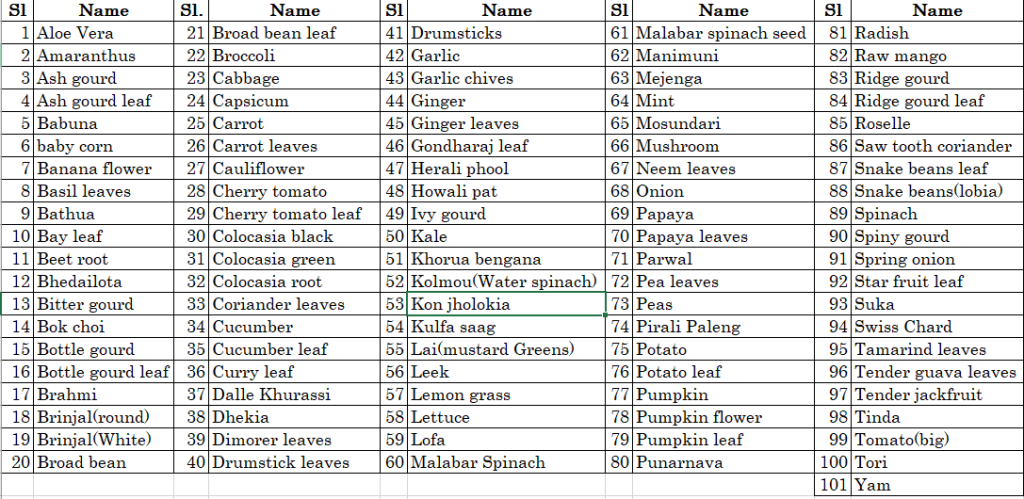
Coming back to the 101 Xaak, it isn’t limited to greens alone. Vegetables like raw mango, papaya, and many others also find their way into the dish, as Mousumi explained. She was kind enough to share the complete list of ingredients with me which I’ve shared below.
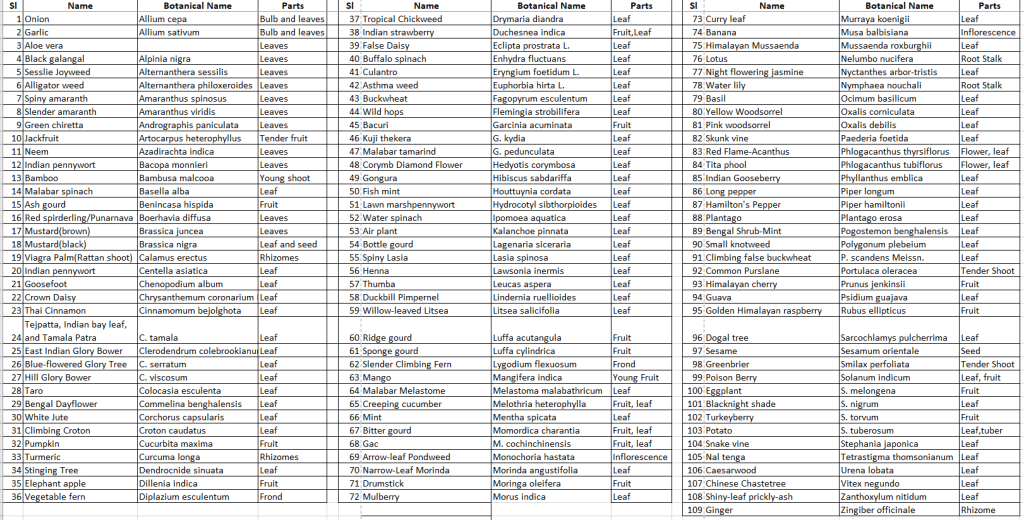
Later, I got to read a publication from Indian Journal of Traditional Knowledge(IJTK) which gave further information on this with a different set of ingredients. A few notes from the publication – “people collect 101 plant species, which are locally known as Akhoh ata sak and prepare recipe in the evening. They believe that this special recipe has some medicinal values, which is good for health for the next year too“. “Although 109 plant species are enumerated in the study (the below table), usually 101 species are used to prepare the recipe. Due to unavailability of some species in some areas another species are selected from these 109 species“
Whether it is Assam’s 101 Xaak, Kerala’s Pathila Thoran, these dishes carry centuries of wisdom about living in rhythm with nature. Each recipe is a reminder of how our ancestors foraged, cooked, and ate with intention. Maybe we cannot cook with 101 plants today, but perhaps we can start with one or two, and in doing so, keep the spirit of these traditions alive.
Read more
- A blog post about 101 herbs dish by Sanchayeeta Parashar
Archana.
 MY LITTLE THOUGHTS LANE
Leave a comment