
One of the most commonly seen edible plants across India. Though not originally a native to India, it has been naturalized here for many years. Among the several species of Solanum, there are 2 look alike varieties(commonly seen) which has black/dark purple berries — Solanum americanum and Solnum nigrum are called as Indian Blacknight shade. Known in many local names like Manathakkali/Kaage soppu/Ganike soppu/Kaashi soppu/Makoi/Patkayai/Kakmachi. To a beginner, they may appear almost identical and it takes a bit of observation to tell them apart. Hence, the botanists call them as ‘Solanum nigrum complex’
Both have edible leaves and berries, though only fully ripe berries are eaten raw, the unripe berries and tender leaves are always cooked before consumption.
Botanical name: Solanum nigrum
Common names from flowersofindia.net : Black nightshade, Black-berry night shade, Nightshade, Poisonberry • Manipuri: ꯂꯩ ꯄꯨꯡꯈꯥꯡꯒ Leipungkhangga • Tamil: மணதக்காளி Manatakkali • Hindi: Mokoi मोकोय • Malayalam: Mulaku-thakkali • Telugu: Kasaka • Kannada: ಕಾಕಿ Kaaki, ಕಾಚಿ Kaachi ಗಣಿಕೆ Ganike, ಬೆಲ್ಲಗಣಿಕೆ Bellaganike, ಕಾಕಮಂಚಿ Kaakamanchi, ಕಾಕಮುಂಚಿ Kaakamunchi • Marathi: Laghukavali • Urdu: Makoya मकोया • Tangkhul: Hantehan • Nepali: कालो बिही Kaalo Bihee, काली गेडी Kaalee Gedee, जङ्गली बिही Jangalee Bihee
Family: Solanaceae (Potato family)
Etymology:
Solanum: Its derivation is uncertain, possibly stemming from the Latin word sol, meaning “sun”, referring to its status as a plant of the sun as per Wiki
nigrum: From the Latin word meaning black.

Botanical name: Solanum americanum
Common names from flowersofindia.net : American Black Nightshade • Hindi: चिर्पोटी Chirpoti, Gurkamai, Gurkkamai • Kannada: ಕಾಕಿ Kaaki, ಕಾಚಿ Kaachi, ಬೆಲ್ಲಗಣಿಕೆ Bellaganike, ಗಣಿಕೆ Ganike, ಕಾಗೆಹಣ್ಣಿನ ಗಿಡ Kaagehannina gida, ಕಾಕಮಾಚಿ Kaakamaachi • Malayalam: manatakkali, nelen-tsjunda, karimtakkali • Marathi: kaamoni, lalgooka batooli • Sanskrit: kakamaci, bahuphala, bahutikta • Tamil: Irekulicam, Kakachi • Telugu: Gajuchettu, Kaachi, Kaakamaachi • Urdu: Ab makoh, ﻣﻜﻮﻩ ﺧﹹﺸﻚ Makoh khushk
Family: Solanaceae (Potato family)
Etymology:
Solanum: Its derivation is uncertain, possibly stemming from the Latin word sol, meaning “sun”, referring to its status as a plant of the sun as per Wiki
americanum: From the Latin meaning “of America” or “originating from America.”
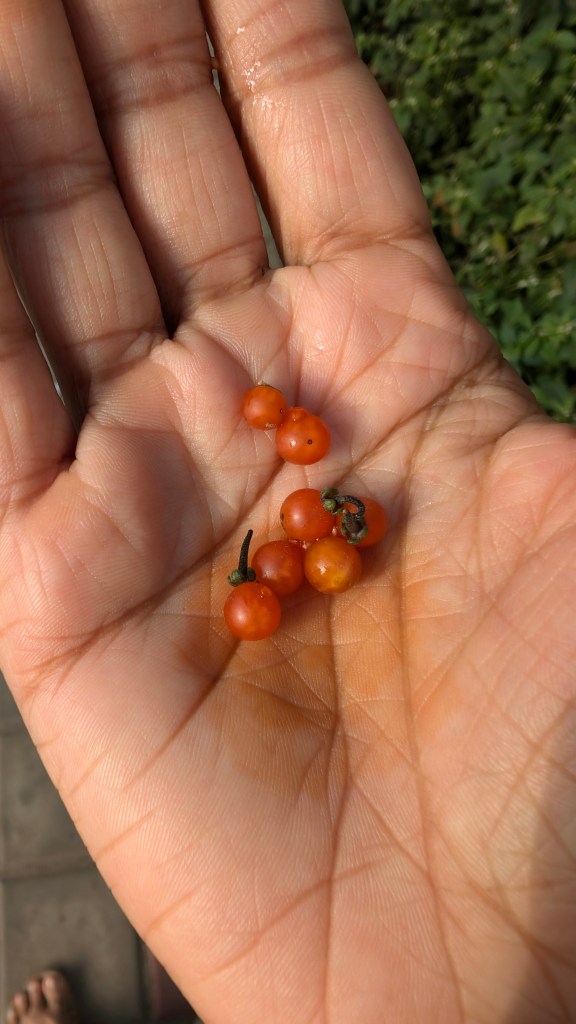
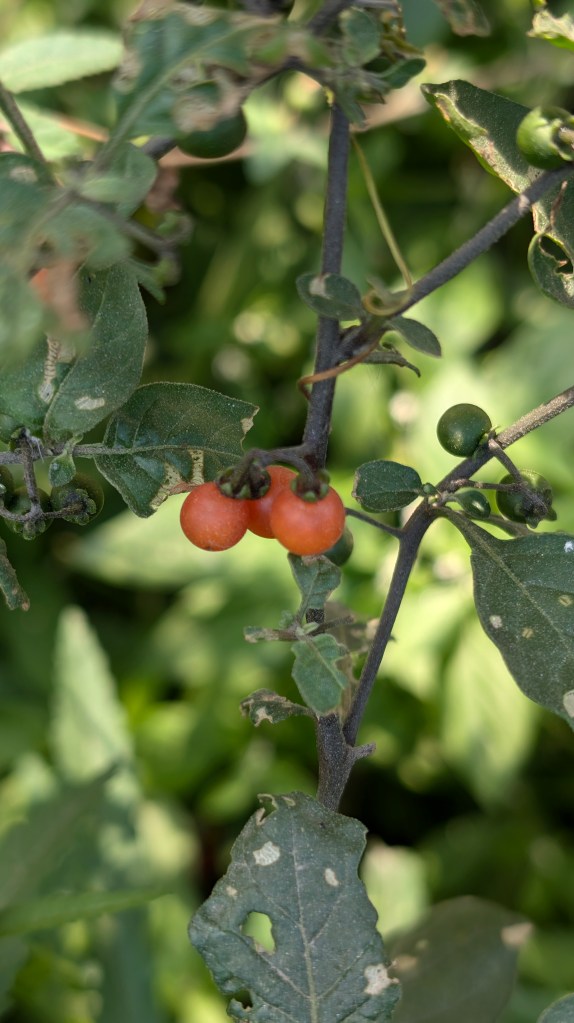
Botanical name: Solanum villosum
Common names from flowersofindia.net : Yellow Nightshade, Hairy Nightshade, Red-fruited nightshade • Sanskrit: कोविदारः Kovidaraha, रक्तकोविदारः Raktokovidaraha
Family: Solanaceae (Potato family)
Etymology:
Solanum: Its derivation is uncertain, possibly stemming from the Latin word sol, meaning “sun”, referring to its status as a plant of the sun as per Wiki
villosum: From Latin villosus = “hairy” or “covered with soft hairs.”
This refers to the fine hairs on the stems and leaves of this species, which give it a slightly velvety texture.
The Red or Orange variety — S. villosum is not a very commonly seen plant. And some have reported yellow too. Though I have seen the red/orange variety, I m yet to see the yellow.

S. americanum and S. villosum
Source – Prakruthiyude Koottukar
It is used traditionally for stomach ailments, ulcers, fevers, and skin disorders. We generally eat the black ripe berries(4.5) and very tender leaves(2-3) daily when we suffer with mouth ulcers and effect can be seen in very few days itself.
Many research papers on Indian black nightshade focus on its traditional medicinal uses and pharmacological properties, such as antioxidant, anti-inflammatory, and anti-cancer activities, as well as its use in traditional medicine for treating liver and skin conditions. Studies have also investigated its molecular and systematic aspects in India and its potential antimicrobial effects.
Since the unripe fruits contain the toxin solanine, only the fully ripe fruits should be used for eating raw. Otherwise needs to be cooked in some form. So people soak the unripe green berries in buttermilk and then soaked under sun, and the step is repeated until they are well dried. Isn’t it a brilliant way to store this wonder berries for longer at the same time removing the natural toxins from the plant and make it safe to consume?

Recipes
- Chidmidikki pallya sukke – A Konkani dish
- Manathakkali Vathakuzhambu
- Koottu
- Thanni saaru
- Phutka pakauri & bread/chapati – By Amrita Singh, published on Down to Earth as well as First Food Series book – Culture of Taste
- Chutney, Soppina Saaru, Hal Saaru from Chasing Soppu book
- Stir fry with moth beans
- Ganike soppu kootu
- Ganike hannu gojju
- Manathakkali berry jam
- Manathakkali rasam
- Manathakkali Vathal Kuzhambu
- Manathakkali Poricha Kootu
- Keerai masiyal
- Manathakkali thanni saaru
- Makoi leaves rice
- Ganike soppu sambar
- Thokku
- Vathal podi and how to make the vathal(sun dried)
- Chukkutti Mezhukupuratti
- Raita
 MY LITTLE THOUGHTS LANE
Leave a comment