
This is the 4th plant in the series of Rooted in Nutrition, after Tapioca/Cassava, Sweet Potato & Winged Beans.
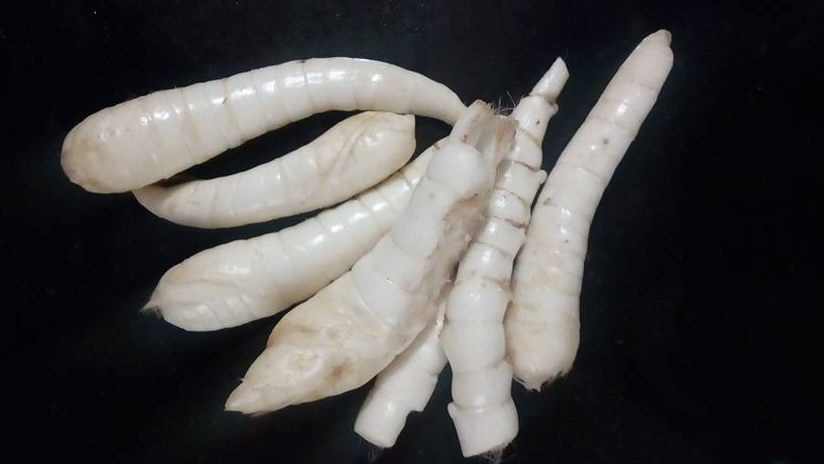
Source: Valsala Gangan
Botanical name: Maranta arundinacea
Common name from flowerofindia.net: West-Indian Arrowroot, obedience plant, Bermuda Arrowroot • Hindi: अरारोट Ararot, Tikhor, Tikkor • Kannada: kuvehittu, tavaksiri • Malayalam: kuva, kuvva • Manipuri: Alalu • Mizo: Thialbal • Sanskrit: तवक्षीरी Tavaksiri, Tugaksiri • Tamil: araruttukkilangu, aruruttukkilangu, kookai neer • Telugu: Palagunda, Palagunta
Family: Marantaceae (Arrowroot family)
From my notes: In Malayalam, it is also known as വെള്ളക്കൂവ/Vella (white), ബിലാത്തി കൂവ/Bilaathi, രാജകൂവ, കൊച്ചി കൂവ/Kochi koova, ലാത്തി കൂവ
Etymology:
Maranta: Named after Bartolomeo Maranta, a 16th-century Italian botanist and physician, who studied medicinal plants.
arundinacea: Derived from the Latin word arundo, meaning “reed” or “cane,” and acea, meaning “resembling” or “pertaining to.” This refers to the plant’s reed-like growth habit.
Larval Host Plant
Psolos fuligo – Dusky Partwing

We all must have heard about the arrowroot biscuits. But have you seen the real Arrowroot? The plant is called arrowroot because of its historical medicinal use in treating wounds caused by arrows. Indigenous peoples of the Caribbean(The arawak) and South America used the starch extracted from its rhizomes to draw out toxins from arrow wounds, helping with healing and reducing infections. It is also believed that the word ‘arrowroot’ comes from the carib word ‘araruta’ meaning mealy roots and they also call it aru-aru means meal of meals.

Pic courtesy- Bala Krishnan
Additionally, the name “arrowroot” may also come from the way its underground rhizomes grow in a cluster, somewhat resembling a bundle of arrows. Over time, the term became associated with the plant’s edible starch, which is widely used as a natural thickening agent in cooking.
Radio-carbon dating has established that M. arundinacea was one of the first plants domesticated in prehistoric South America. Interesting right?
Uses
The rhizomes are generally used to make an extremely fine, highly digestible starch known as arrowroot starch/powder. It is regarded as food, especially for babies, and is used in puddings, cakes, and biscuits. The demulcent qualities of this starch make it useful for treating gastrointestinal ailments. Additionally, used as a foundation for face powders. The rhizomes can be consumed boiled or roasted.
My family uses this when we experience loose motions due to indigestion. We dilute a small spoon of powder in 1-2 glasses of water, boil and cook well(it becomes thick), consume this slowly once a day. Please do repeat this more than 4-5 days. Also my mother used to make a halwa kind sweet called duddali(a popular Konkani dessert) especially during Summers as it cools down body.
During several festivals, such as Thiruvathira in the month of Dhanu (about 16 December to 15 January), tubers are highly valued in Kerala. Those days arrowroot is used for preparing koova payasam, puzhungiyath and many more dishes.I will discuss it in a different blog post because it is a vast topic in and of itself.
It contains Potassium, Calcium, Iron, Magnesium & Vit B6 apart from the carbohydrates, proteins . Also it helps for better bowel movements(esp in diarrheas’) , boosts metabolism, cools body, supports immune system.. It has been used in cosmetic products as it absorbs excess oil and sweat.
Recipes
- Arrowroot biscuits – with whole wheat flour & arrowroot starch
- Biscuits – with Almond flour & egg
- Uraro Cookies – with All purpose flour(maida) & egg – a Filipino recipe
- Uraro cookies – with arrowroot flour & egg
- Koova puzhukku – Kerala style
- Koova upperi
- Koova Kurukku
- Koova payasam
- Palua laddoo, almost a 100 years old recipe from Bhadrak district, Odisha.
- Recipes from Srilanka
- Koova kaachiyath
- Koova curry
- Koove pitta duddali – A Konkani dish
While this variety is the main source for Arrowroot, the starch is extracted from various other species too.
East Indian Arrowroot
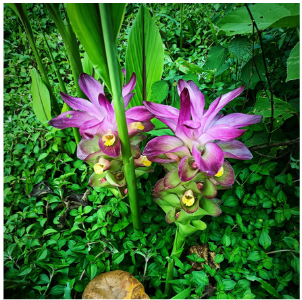
Botanical name: Curcuma angustifolia
Common name from flowerofindia.net: East Indian Arrowroot, Bombay arrowroot • Hindi: Tikhur तिखुर • Bengali: Keturi halodhi • Manipuri: Yaipan • Marathi: Tavakeera, Tavakhira, Tavakila • Malayalam: Koova, Kuva-kizhanna • Nepali: बर्खे सर्रो Barkhe Sarro • Tamil: Ararutkilangu, Kua, Ararut-kizhangu • Kannada: Koove-hittu • Tangkhul: Koktuiwon • Telugu: Ararut-gaddalu • Sanskrit: तवक्षीर Tavakshira
Family: Zingiberaceae
From my notes: In Malayalam, it is also known as മഞ്ഞക്കൂവ/Manja (yellow),
Etymology:
Curcuma: Derived from the Arabic word kurkum, meaning “turmeric,” which is also linked to the Sanskrit word haridra (हरिद्रा). The genus Curcuma includes many species of rhizomatous plants, including turmeric.
angustifolia: Derived from the Latin, angustus meaning “narrow” and folia, meaning “leaf”
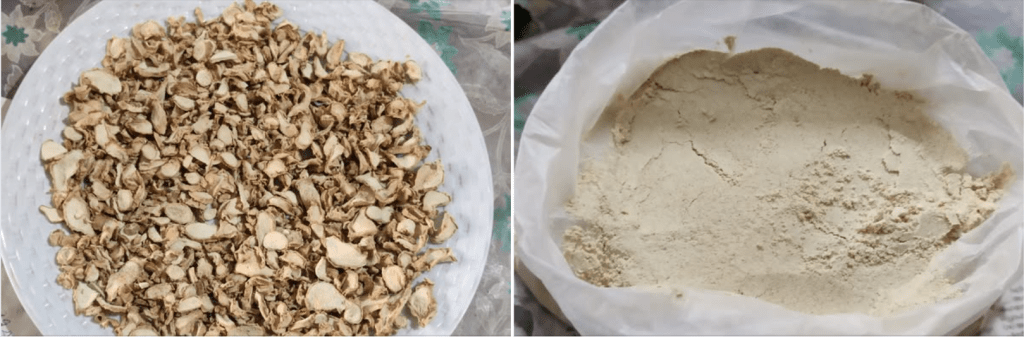
The rhizomes are large, fleshy, branched, the inner part of which is pale yellowish brown in color. In contrast to white arrowroot, the yellow variety absorbs greater amounts of toxins from the upper soil, resulting in rhizomes that are more bitter and astringent. As a result, animals such as rats, porcupines, and wild boars typically steer clear of consuming them. In Malabar region(esp. Malappuram, Kozhikode, Wayanad, Kannur and Kasaragod, Kerala), this plant is the major source for arrowroot powder. It is cleaned, washed many times to ensure the powder is the finest and then sun dried before storing.

Arrowroots & turmeric are planted near trees like mango, jackfruit as it prevents trees being attacked by termites. Also they are shade loving plants as well the leaves from the trees would add as a mulch for their soil which aids the root growth.
Unfortunately, this type is incorrectly marketed as ‘Kasturi manjal/Kasturi turmeric/ Musk turmeric/ Curcuma aromatica’ since the rhizome and the powder are yellowish/orangish in color. Kasturi turmeric is mainly used for cosmetic purposes. It is added in ubtans, face masks etc. for giving a coolness and has many medicinal properties too.
Blue arrowroot
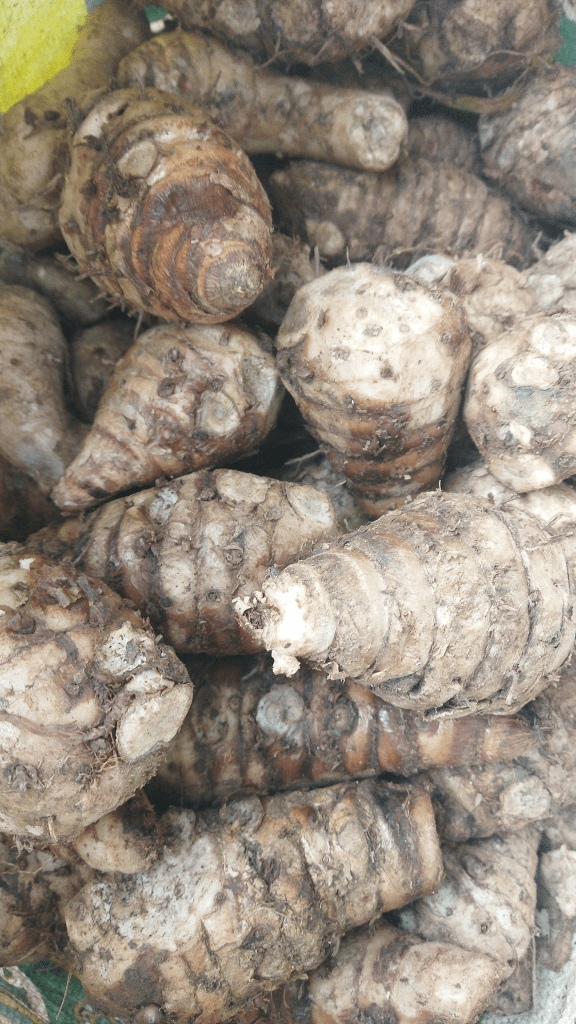
Botanical name: Curcuma aeruginosa (most probably)
Family: Zingiberaceae(Ginger family)
From my notes: In Malayalam, it is also known as നീലക്കൂവ(blue arrowroot), കാട്ടു കൂവ(wild arrowroot)
Etymology:
Curcuma: Derived from the Arabic word kurkum (كركم), meaning turmeric, which traces back to the Sanskrit word haridra (हरिद्रा).
aeruginosa: From the Latin word aeruginosus, meaning “bluish-green” or “copper-rust colored.” This refers to the rhizome’s distinct bluish tinge when cut, a key identifying feature of the plant.
This type produces a white powder that is used as arrowroot powder. Both the yellow and this species are found in the wild, making them easily available and doesn’t need much care.
Similar to West Indian arrowroot and Kasturi turmeric, this is also marketed as “black turmeric” by many, either to deceive or because they are ignorant of the difference. I have provided additional information about each of these plants below, so please exercise caution if you are purchasing anything under these names.

Differences between various plants
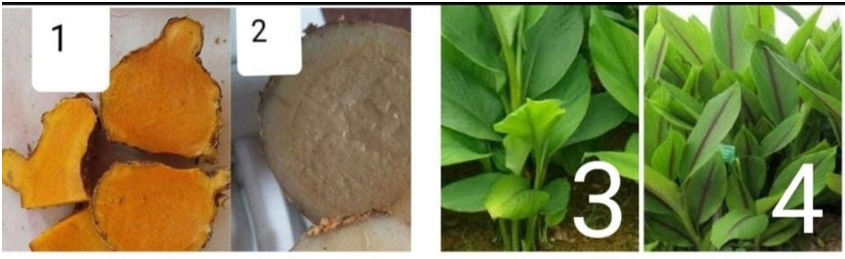
2 & 3. Kasturi turmeric
Rubbing the yellow arrowroot tuber on your skin results in a yellow stain, and occasionally a tingling or mild burning sensation may be experienced. However, when you rub the Kasturi turmeric or apply the paste, you will experience a sensation of coolness. Kasturi turmeric will also have a mild camphor.
Source – Jayasreechandran Chandran

Pic courtesy – Lipin

2. Blue arrowroot 3. Yellow Arrowroot
The leaves of all three plants appear alike. Although the distinctions may not be readily noticeable, the black turmeric displays a dark tint from the base to the tip of the leaf. The blue arrowroot extends from the middle middle. Yellow arrowroot possesses it from the start to the midpoint. But this varies due to location, soil composition etc. which makes it harder to distinguish just seeing the plants.
I happened to look at the ingredients of arrowroot biscuits in the store and figured that the actual ingredient, arrowroot, is only 0.1%. No, it didnt surprise me as I have noticed this marketing gimmick for selling items -eg. Wholewheat biscuits, breads,..

Sometimes I do wonder, ‘In this fast-paced world, are we overlooking the delicate care of roots that have supported generations?’ Do share your thoughts in the comments.
A.

 MY LITTLE THOUGHTS LANE
Leave a comment